In the vast realm of global technology, there’s one name that stands out: Lei Jun. From humble beginnings in rural China to becoming the CEO of Xiaomi, Lei’s journey is not just a testament to hard work but also to resilience, reinvention, and unyielding belief in accessibility. Known as the “Steve Jobs of China,” his story resonates with anyone who’s dared to dream big and defy the odds.
The Early Days: A Code Breaker’s Journey
Born in 1969 in Xiantao, a small town in Hubei, Lei Jun’s early life was defined by scarcity. Raised by teacher parents, his childhood lacked luxuries, but it was rich in discipline. At 14, Lei’s hunger for knowledge drove him to walk miles to borrow textbooks, sometimes copying lines of code by candlelight. That grit powered his academic success, allowing him to graduate from Wuhan University with a degree in computer science in just two years, an impressive feat in itself.
But it wasn’t all smooth sailing. Lei’s first entrepreneurial venture, a virus-killing software, met a catastrophic failure when pirated versions flooded the market. However, the $1.6 million he earned, a fortune in 1990s China, didn’t just cushion his fall. It fueled his next act and set him on a path to take on global giants.
Kingsoft and the “Model Worker” Syndrome
Lei’s early professional years saw him rise quickly through the ranks at Kingsoft, a Chinese software company. By 28, he was CEO, but despite his success, he found himself trapped in a relentless work cycle, micromanaging and sacrificing his personal life. In his pursuit to challenge Microsoft, he worked tirelessly, often sleeping under his desk.
However, despite leading Kingsoft to a successful IPO in 2007, Lei felt an overwhelming sense of emptiness. His self-reflection led him to an epiphany: hard work alone wasn’t enough. In 2009, during a quiet moment at a Beijing bar, Lei realized he had been a “stubborn pig fighting the wind.” It was time for a change.
From Failure to Innovation: The Birth of Xiaomi
In 2010, Lei co-founded Xiaomi with the ambition of revolutionizing the tech industry. His vision wasn’t just to create affordable smartphones; he aimed to democratize technology, making high-quality devices accessible to all. Xiaomi’s “honest price” philosophy, delivering premium specs at a fraction of the price, was disruptive. His “Triangle of Death” model integrated hardware, software, and online services, a strategy that set Xiaomi apart from competitors.
At first, the tech world didn’t take him seriously. Top suppliers rejected Xiaomi’s pitch, branding it a “copycat” company. But Lei Jun, ever the optimist, believed in the vision. When Xiaomi’s first phone, the Mi 1, was released, they sold 7.2 million units in the first year, a number that turned the doubters into believers.

The Struggles and Rise Again
Like all entrepreneurs, Lei faced his share of obstacles. From 2015 to 2019, Xiaomi went through a turbulent phase, facing supply chain issues, market share losses, and copycat accusations. But Lei didn’t quit. Instead, he adapted. He took direct control of R&D, overhauled Xiaomi’s supply chain, and opened physical stores to combat online saturation.
By 2018, Xiaomi made its way onto the Fortune 500 list as the youngest-ever company to do so. Despite the difficulties, Lei’s leadership was pivotal in guiding Xiaomi out of the valley of shadows, setting the company on a growth trajectory that would soon dominate the market.

Xiaomi’s Bold Leap: Entering the Electric Vehicle Market
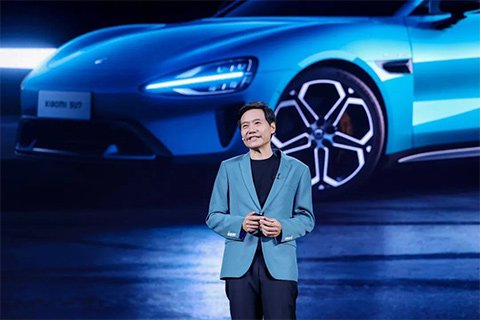
In 2021, Lei made an audacious move, announcing Xiaomi’s entry into the electric vehicle (EV) market. At the time, the industry was plagued with uncertainty, but Lei’s “10% Penetration Rule” became his guiding light. He waited for the tipping point where tech adoption was significant enough, and when it came, Xiaomi jumped in headfirst with the launch of the SU7 sedan.
The gamble paid off. The SU7 became a premium EV contender, topping China’s premium EV charts within months of its launch. But even with this success, Lei faces new challenges in scaling production. The demand for the YU7 SUV, Xiaomi’s next EV, has overwhelmed the company’s manufacturing capacity, creating a backlog of pre-orders that stretches into 2027.
Leadership, Legacy, and the Man Behind Xiaomi
At 56, Lei Jun remains a paradox. A workaholic who advocates for work-life balance, a disruptor battling his own company’s growing pains, Lei’s leadership is built on the lessons of his past. His mantra: “In the storm, we are reborn,” encapsulates the core of his approach to business, constant reinvention.
Beyond business, Lei’s philanthropic contributions, including a $185M donation to Wuhan University, underscore his belief in giving back. Despite being a private man, his impact on China’s tech ecosystem and the broader global market cannot be overstated.
Conclusion: The Relentless Architect of China’s Tech Revolution
Lei Jun’s story is one of resilience, vision, and relentless reinvention. From a small town in Hubei to becoming the face of China’s tech revolution, his journey proves that with the right mindset, even the most daunting challenges can be overcome. As Xiaomi continues to grow, so does Lei’s legacy, a testament to how vision, courage, and innovation can change the world.
Leadership, Legacy, and the Man Behind Xiaomi
At 56, Lei Jun remains a paradox. A workaholic who advocates for work-life balance, a disruptor battling his own company’s growing pains, Lei’s leadership is built on the lessons of his past. His mantra: “In the storm, we are reborn,” encapsulates the core of his approach to business — constant reinvention.
Beyond business, Lei’s philanthropic contributions — including a $185M donation to Wuhan University — underscore his belief in giving back. Despite being a private man, his impact on China’s tech ecosystem and the broader global market cannot be overstated.
Conclusion: The Relentless Architect of China’s Tech Revolution
Lei Jun’s story is one of resilience, vision, and relentless reinvention. From a small town in Hubei to becoming the face of China’s tech revolution, his journey proves that with the right mindset, even the most daunting challenges can be overcome. As Xiaomi continues to grow, so does Lei’s legacy, a testament to how vision, courage, and innovation can change the world.